
India is at the cusp of a data revolution:
Only a decade ago, it would be difficult to imagine India as a powerhouse of data innovation. In 2014, one in five Indians were wired to the internet. Fast forward to 2024 – and this number has more than doubled.1 Data consumption, use, innovation, and adaptation is going places. Government, funders, corporations, and civil society have all helped with tinkering to solve both simple and complex societal challenges.
There is a need to strengthen the data for good ecosystem:
As this trend continues to take shape, there is a need to organize and strengthen the data for good ecosystem – moving it closer to a unified field that incorporates data as a resource for inclusion, agency, and empowerment, with multiple actors focusing on harnessing the approach. This thought is gaining momentum and can benefit from support and action.
Unlocking the Virtuous Cycle of Data Empowerment can build momentum for systemic change:
The Virtuous Cycle of Data Empowerment focuses on an approach where communities are not just recipients but active owners of data, enabling them to drive their own development agendas and fostering a more inclusive, resilient future. By breaking down barriers faced by communities in accessing, using, and understanding data – it is a tool for empowerment that provides the most vulnerable communities with the agency to drive solutions.
Civil society organizations are leading the data for good movement:
In recent years, data-driven solutions have revolutionized systems across sectors, but this shift has also inadvertently excluded marginalized communities, particularly in rural India, women, and those without access to digital literacy. This digital divide limits the ability of these groups to participate in decision-making processes and harness data for development. CSOs are helping communities with the resources to challenge, create, and leverage data to actively address their own development needs. By supporting community members and leaders, CSOs are dismantling negative feedback loops, leveraging data to create local innovations, claiming the right to access data for action, and demanding access to data for creating tangible impact.
The Data for Good Exchange Initiative has had three-fold growth, and is still growing:
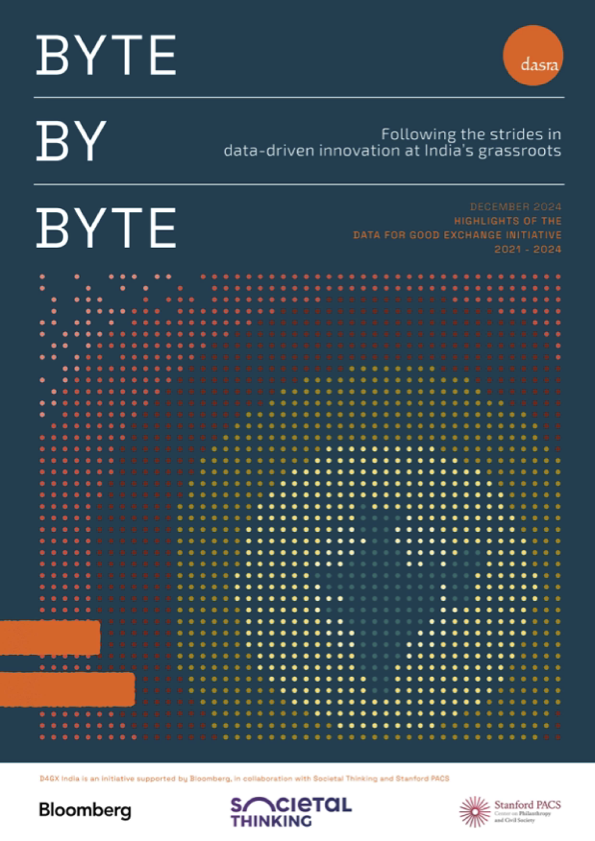
The Data for Good Exchange (D4GX) Initiative is an effort, aiming to empower communities with the resources, capacity, and knowledge to unlock the virtuous cycle. The D4GX India Initiative has embedded itself as a backbone alongside India’s thriving CSOs, engaged in driving the agenda of ‘data for good’ at India’s grassroots. Through the cohorts, anchored since 2021 and 2024, the initiative has gathered seeds of knowledge that underscore the transformative potential of data in addressing societal challenges. The report shares learnings, insights, and practical case studies documenting the experiences of India’s thriving civil society, championing this front. It also showcases the voices of community leaders and experts, reflecting their perspectives on the movement.
Building the field for data empowerment necessitates collective action:
To fully realize the India’s potential for data empowerment, CSOs, governments, and funders must work in tandem to create a robust data ecosystem. CSOs, with their deep-rooted connections to communities, can leverage local insights to drive data-driven impact. Governments play a pivotal role in safeguarding data privacy, fostering data integration, and supporting data innovation for public good. Funders can align investments, encourage partnerships, and nurture innovation, to harness the power of data. This collective effort will not only benefit India but also serve as a model for the Majority World, paving the way for a more informed, inclusive, and resilient future for people and the planet.
Highlights from the D4GX India Journey
Catalytic impact across thematic areas: Through sustained support, mentorship, and network building, the D4GX India Initiative has built nascent evidence base for catalytic impact. The impact plays out across its five key thematic areas: Equitable Health, Community Building & Resilience, Learning to Livelihoods, Urban Governance & Sanitation, and Climate & Sustainability.
Multifold solutioning at play: By analyzing ~500 applications from CSOs across India this report unveils the unique challenges that communities in remote, rural, impoverished, and marginalized circumstances face. The report categorizes the multiple modes used to expand service delivery, strengthen community ecosystems, build policy reforms, and demonstrate how data can drive systemic change and promote inclusive, sustainable development
 Thought Leadership
Strategic Philanthropy
 Playbooks & Toolkits
Strategic Philanthropy
 Thought Leadership
Strategic Philanthropy

Explore 25+ years of Dasra's research and knowledge products, covering underserved sectors, philanthropy trends, and civil society action across India.